 |










 |
|
||

|
|||



















 ‘Nobody dared enter this grove except the priest; and even he kept out at midday and between dusk and dawn – for fear that the gods might be abroad at such hours.’Classical writers such as Caesar, Ptolemy and Tacitus, especially those who had travelled in Gaul and parts of Britain, made direct links between sacred groves and mounds and localised worship and priesthood. Other sites of worship probably included clusters of oak-trees, individual trees, lakes, river-crossings, the sites of springs or wells and any part of the landscape that was considered to be possessed by, or the home of, a spirit. The Gaulish word for a grove was nemeton – nemed in Irish. This has been incorporated into the names of relevant deities such as Nemetona and Aremetia. Much Celtic worship appears to have been carried out in the open air and few of the Classical writers made specific reference to religious buildings or temples. It must be remembered that writers from the Roman world wished to show their Celtic neighbours as primitive and were presenting a contrast to the soaring columns and lavish temples that characterised Classical religious architecture. No archaeological evidence has been found of Celtic holy buildings dating from an early period. This would coincide with the Celts' close connections with the land on which they lived. Religious structures would start to emerge only under Roman influence as shrines and minor temples were built. This does not mean that there were no specified sacred sites in this early period and that they were not marked in a significant way. Space itself was regarded as sacred within Celtic religion and the druids took care to enclose especially sacred areas. Within this area the god or spirit was supposed to focus its powers. The enclosures might have been surrounded by a stone wall, thick hedge or deliberate growth of trees, by a ditch or a simple wooden palisade or by a combination of any of these. Such fortifications were designed to cut off the sacred from the profane and to concentrate the powers of the particular spirit within a specified locality, the enclosed ground then becoming holy. Islands, being self-enclosed by water, were important sites. There are many Classical references to sacred islands around the coastlines of Britain and Gaul. Some of these were burial grounds on which cults of the dead flourished - it was believed that the spirits of the dead could not cross water. Some were the abodes of dark forces that demanded veneration from afar. Later, many of these sites would become churches and hermit cells during the early Christian period. In Celtic folklore, boundaries are significant and this might stem from the demarcation between holy and profane ground. In both Scottish and Irish folklore an effective curse against an individual could only be made on a boundary line; it symbolised the separation of the mortal world from the mystical, supernatural Otherworld. To step across such a boundary was to venture from one world into the other; from the world of men into the realm of gods and spirits. The priests themselves might have lived close to land boundaries as did the hermit monks and learned men of the later Christian period. Bogs, rivers and lakes were also places of worship. Here, the nature of the ground and space changed significantly and, in the early mind, this marked a difference between one type of existence and another. For the Celt, the borders of the Otherworld were very close and the places where the gods came and went were exceptionally sacred. The Celts also viewed the land itself in a special way and this vision played a decisive part in their psyche regarding the notion of sanctity. The Soul of the Earth Traditional Celtic teaching informs us that the earth was not viewed by the Celts as simply dead matter but as a living, breathing thing. Furthermore, the material of which it was composed was inextricably bound, like a reflection, to the spirits of those who dwelt on it. Material was therefore filled with spirit and that spirit revealed itself through material. Later commentators would refer to this belief as anima loci – the place-soul or the spirit of place. Acknowledging the sanctity of a place was little more than an acknowledgement of the reflection of that spirit. The best northern European understanding of the notion of anima loci is to be found, not in the recognised Celtic world but in the Landnamabok – The Book of Settlement – in Iceland and its contemporaneous texts. First discovered by Vikings and then by voyaging Irish and Scottish Celtic monks, the land appears to have been settled sometime during the ninth and tenth centuries. The first settlers in Iceland were acutely aware of the ‘personalities’ of places and set areas of the landscape aside to acknowledge and respect them. Certain areas and landholdings were kept aside specially for the landvettir – land-wights or earth spirits – as their own special property. These lands were to be held by the spirits forever. Places of worship in Iceland were developed using geomantic techniques that respected the notions of anima loci; not to do so would have been to invite disaster upon the settlers. Such techniques must have mirrored the activities of the first Celtic settlers when they came to the largely empty and unexplored lands of the West. People directing prayers to sacred mountains, trees or rivers, for example Helgafell, the sacred Icelandic mountain, were often required to wash their faces, put on clean clothes and fast for a day, out of respect for the spirit who dwelt there. Similarly when passing great stones, it was customary for people to raise their caps or make some other sign of obeisance. So common was the practice that Thomas Pennant remarked that there was hardly any large stone in Scotland where the country people did not salute or leave some kind of offering. These small acts of worship gradually inculcated a healthy and general respect for the environment into those who dwelt on the land. The connection to the spiritual aspect of the earth sometimes extended even to the physical appearance of landholders. No king or noble should have a physical blemish or imperfection lest this reflect back on the lands that he owned or the people that he governed. Many of the old tales – e.g. the tale of the able and wise king, Conn of the Hundred Battles who was forced to relinquish the throne after losing an eye – relate the physical appearance of the land to the actions of those who lived on it. This symbiotic relationship meant that disfigured nobles were usually forced to give up their lands in case they brought famine or drought on their community or in case their arrogance offended the land-spirit. During the English occupancy of Ireland, land would be given away by the authorities as payment for services. Cornwall’s administration, bankrupt after the English Civil War was notorious for the parcelling out of Irish land as payment to troops, garrisoned in the country. This English idea of land as a commodity was beyond the comprehension of the Irish whose belief in a deep relationship between living earth and living people, saw the ‘given away lands’ as living, breathing extensions of themselves. It was this love for, and association with, the land that was to fuel the various land-wars in Ireland during the 18th and 19th centuries. Throughout the generations, the Celts tried to keep faith with the land and to respect it as an entity in its own right. Places were usually named after some geological feature or trait of the land and this gave the location a sense of distinction, even of individuality and personality, adding to the sense of ‘being alive’. Its soul, as manifested through the animistic spirits that dwelt within its confines, was inextricably linked with the existence of the people who lived on it. Its special places were their special places as well. Places of the Godsbr> It was well known that many spirits lived in high and often inaccessible places. Remote and aloof from their worshippers on the ground, any devotional ritual at their ‘home’ had to be carried out after a long journey or pilgrimage. Throughout the Celtic world, inscriptions and dedications to aerial spirits and sky gods are to be found scattered throughout mountainous regions. Later associated with the Roman Jupiter, suffixes denoted regional variations. Thus, Jupiter Brixianus at Brescia in Cisalpine Gaul was certainly a local god. Jupiter Ladicus in the mountains of northwest Spain was taken to be the spirit of the mountain and was assimilated into the Roman-Celtic notion of Jupiter. The same practice occurs in Hungary, Dalmatia, Bulgaria, Scotland and Ireland. Croaghpatrick in County Mayo – the most holy mountain in Ireland – was formerly Cruachan Aighle – or Aickle – the seat of an important spirit to which men frequently prayed and made pilgrimage. This later became a Christian site with a pilgrimage up its slopes in honour of the saint, following in the tradition of the pagans. According to Julian of Furness, it was from this mountain that Patrick expelled the serpents and crawling-creatures from Ireland, surely symbolic of the rooting-out of paganism and pagan shrines on the mountain. Mountain/sky gods were often linked with fertility, through the sun and the rain that nourished Celtic crops. It was not enough to worship them from afar; offerings and gifts had to be carried into the very abode of the spirit or god. This meant that there had to be a ‘special place’ at which these gifts or offerings could be given and be received by the deity in question. Thus areas high in the mountains, and often denoted by inscriptions, became places of worship for the sky gods. Similar treatment was accorded to water-gods. This Chapter extract continues with Shrines and Sacred Sites - Part 2>>>.
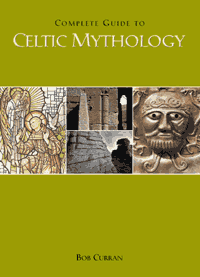
From Complete Guide to Celtic Mythology by Bob Curran |
[ Back to top ]
All Material © 1999-2006 Irelandseye.com and contributors